

Failed hair transplant? How SMP (Scalp Micropigmentation) can save the day
Hair transplantation seems to many as the ultimate solution to hair loss. Advertisements promise a natural result, a restored hairline, and a boost in self-confidence. But reality is not always so ideal. Many people face problems after transplantation that are not often discussed before the procedure.
In this article, we look at the main reasons why hair transplants may not produce the desired results – and how to SMP or scalp micropigmentation can help improve the situation.
Why may hair transplantation not give the desired result?
1. Insufficient density – the most common problem
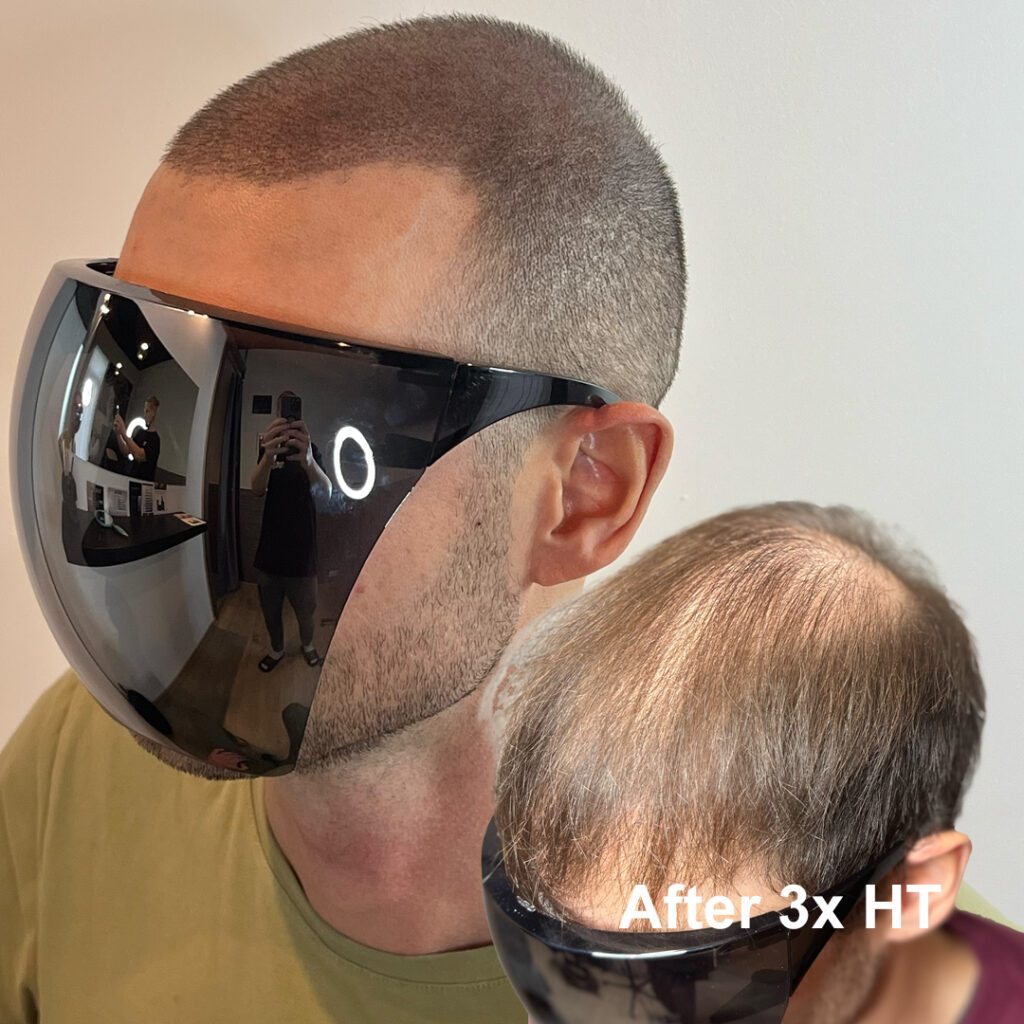
One of the biggest sources of disappointment is that the transplanted hair does not create a dense enough result.
Although thousands of hairs are transplanted during the procedure, the reality is that:
- there is a limited number of graft units in the donor area (usually the back of the head)
- not all hair can be safely repositioned
- hair loss may continue after transplantation
The result is often:
- sparse appearance in bright light
- visible scalp between the hair
- „a “see-through” effect that betrays that there is not enough density

2. Multiple transplants – an endless process
Many patients do not consider that one transplant may not be enough.
Often:
- 2–3 or even more procedures are performed
- Every time they try to add density
- but the resource in the donor area is decreasing
This creates a situation where:
- the results do not improve significantly
- costs are increasing
- healing periods are recurring
And eventually, you still reach a point where the ideal result is not achieved.
3. Over-thinning – damaging the donor area
One of the most critical, but least talked about, problems is overharvesting or overuse of the donor area.
If too many grafts are taken from a donor site:
- hair in the nape of the neck becomes thin
- visible "spots" appear„
- Haircut becomes more limited (cannot be cut shorter)
This can make the entire appearance look unnatural – even if the transplanted area itself is satisfactory.
4. Scars (from FUT and FUE techniques)
Hair transplantation always involves some degree of scarring:
FUT (strip method):
- linear scar on the back of the head
- may remain visible, especially with short hairstyles
FUE method:
- small punctate arms
- may become visible if the donor area is sparse
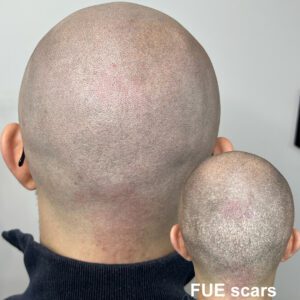
Many people don't consider that:
- scars may be permanent
- they can influence hairstyle choices
- they become more visible with age
5. Hair loss continues
Hair transplantation does not stop natural hair thinning.
This means:
- existing hair may continue to fall out
- an uneven pattern occurs (transplanted vs. natural hair)
- the result may deteriorate over time
How does SMP help repair a failed transplant?
This is where it comes into play. SMP (Scalp Micropigmentation) – a visual solution that does not depend on the presence of hair, but creates an optical illusion.
1. Creating a denser impression
With SMP:
- micropigmentation dots are added to the scalp
- they mimic hair follicles
- reduce the contrast between skin and hair
Result:
- hair appears visually thicker
- the sparseness is no longer noticeable
- the overall result becomes more „fulfilled“
2. Harmonization of the donor area
Overharvested donor area can be treated with SMP:
- visually "fill"„
- hide sparse areas
- restore a more even appearance
This allows:
- wear a shorter hairstyle
- reduce the contrast between scars and hair
3. Hiding scars
SMP is one of the most effective solutions for concealing scars:
- FUT linear scar can be visually „covered“
- FUE puncture scars become less noticeable
- the result is a more even and natural look
4. Hairline correction
If the transplanted hairline:
- is too sparse
- irregular
- or unnatural
then with SMP you can:
- define hairline
- add visual density
- make the entire framework more aesthetic
5. Long-term and stable solution
Unlike hair transplantation:
- SMP is not dependent on hair growth
- the result does not change with hair loss
- maintenance is minimal
What do people often not know before a transplant?
Before undergoing a hair transplant, people often focus only on the promises of the final result. However, in reality, you should consider:
- donor area is a limited resource
- 100% density cannot be restored
- hair loss continues
- scars are inevitable
- multiple procedures may be necessary
It is because of these factors that many people later seek additional solutions.
Summary: SMP as a smart addition or lifeline
If hair transplantation has not produced the desired result, it does not mean that the situation is hopeless.
SMP can:
- create visual density
- to standardize the outcome of the transplant
- hide scars
- improve overall aesthetics
Often, it is the SMP that provides the „final touch“ that makes the result truly good.
If you are considering a solution to improve your hair transplant results, it is definitely worth investigating how SMP could help in your situation.